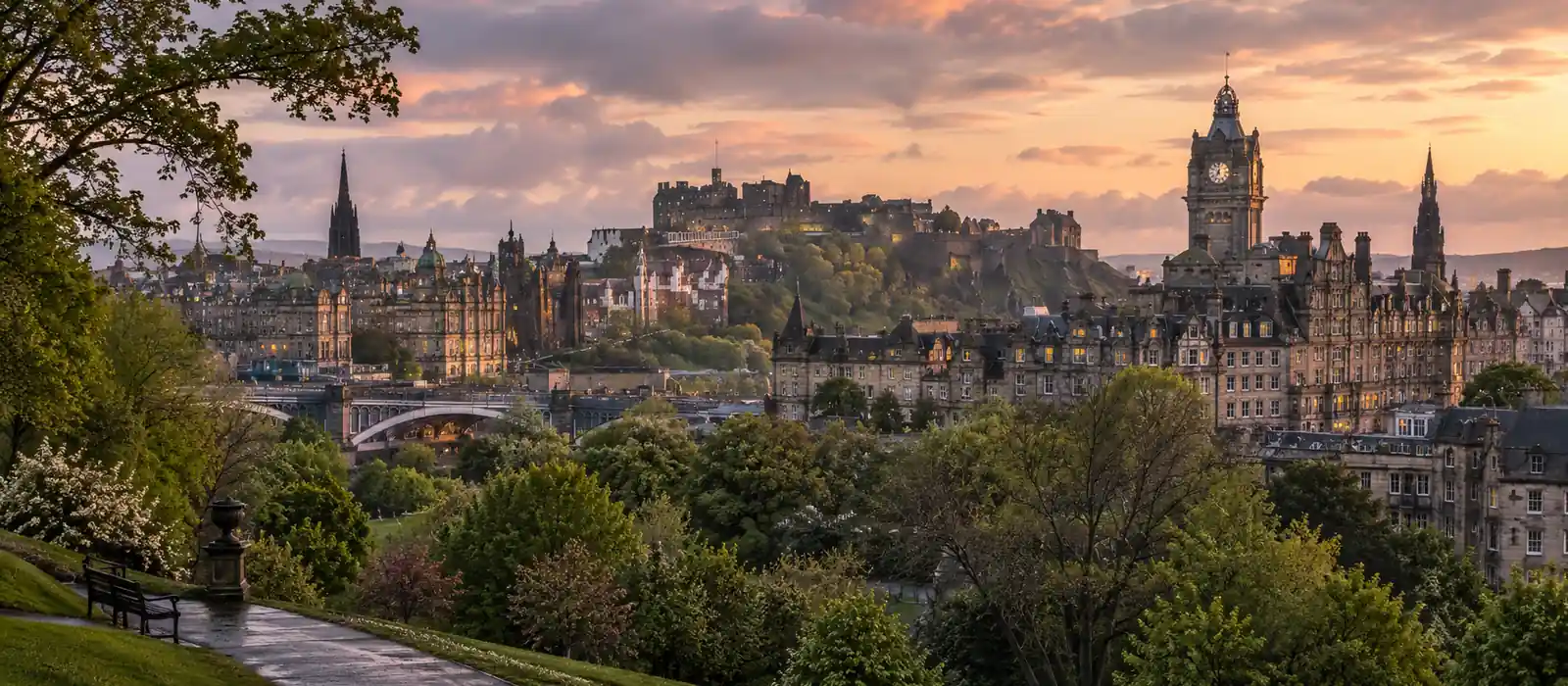
Edinburgh accommodates visitors across 318 hotels and guest houses spread through its UNESCO World Heritage districts. The Old Town winds up the volcanic rock toward the castle with medieval closes and restaurants in 17th-century basements. The New Town spreads north in Georgian squares and crescents. Leith sits at the shore, transformed in recent decades from notorious to fashionable. Stockbridge and Morningside offer quieter residential character. Each district attracts a different kind of guest, and there is established, luxury accommodation in every quarter.
Where to stay in Edinburgh
Old Town The Old Town clusters beneath Edinburgh Castle, with the Royal Mile running its spine and narrow closes twisting downhill toward the present-day street level (often the roof of the 17th-century building below). It is the most visibly historical part of the city, crowded with restaurants, galleries, and tourists. Hotels here are immediately convenient for first-time visitors and anyone coming for the castle and historic Edinburgh. The trade-off is noise and crowds.
New Town The New Town was designed in the 1760s in Neo-Classical squares and crescents—Princes Street, George Street, Royal Crescent. It feels more spacious and orderly than the Old Town, with the National Gallery and museums nearby, and Queens Street Gardens offering green space. The area is quieter and more residential in feeling while remaining central. Hotels here serve those seeking order and 18th-century architecture.
Leith Leith sits at the Water of Leith near the sea, now a trendy neighbourhood of independent restaurants, galleries, and shops. It is not immediately central—a short bus ride or walk from Princes Street—but it is where Edinburgh’s younger residents and visitors seeking emerging neighbourhoods choose to stay. The waterfront offers a different pace and views.
Stockbridge North of New Town, Stockbridge is a quiet residential neighbourhood of independent shops, cafés, farmers’ markets, and Georgian townhouses. Accommodation here is sparse but character-filled. Visitors who want to experience how Edinburgh residents live choose this area.
Morningside South of the city centre, Morningside is traditional Edinburgh: Victorian terraces, local pubs, and the Royal Edinburgh Hospital. It offers a domestic experience far from tourist crowds.
The best hotels in Edinburgh
The Balmoral
The Balmoral occupies a corner of Princes Street in a château-style building completed in 1902. It holds 187 rooms and suites; the Forbes Five-Star rating marks it as Edinburgh’s only five-star hotel. The property is known for Number One, a Michelin-recommended restaurant, the Afternoon Tea service in the Palm Court, and the Irene Forte Spa. Guests staying here make a statement about arriving at Edinburgh’s most ceremonial address.
Waldorf Astoria Edinburgh – The Caledonian
The Caledonian opened in 1903 and was rebranded under the Waldorf Astoria label in 2012. It holds 241 rooms and suites with views of Edinburgh Castle. The property features two award-winning restaurants, an indoor pool, and the Guerlain spa. It appeals to guests seeking established grandeur and the sense of staying in a building where Scottish history has turned.
Prestonfield House
Prestonfield sits in a country-house setting 20 minutes south of central Edinburgh, set within 20 acres of parkland. Despite its location, it operates as a luxury hotel with 23 elegantly appointed rooms. Each booking includes welcome champagne and breakfast at the restaurant Rhubarb. The appeal is solitude and countryside within reach of the city—the opposite of central hotels.
The Scotsman Hotel
The Scotsman occupies a red-sandstone Baroque building on North Bridge, formerly the headquarters of Scotland’s national newspaper (opened 1905). The 82 rooms feature period character—exposed brick, wooden panels—combined with contemporary luxury. The building holds a 48-seat cinema (Picturehouse), three bars (Grand Café, The Hide whisky bar, The Press Bar), and a fitness centre. It is ideally placed between Old Town and New Town, and appeals to those seeking literary Edinburgh and design.
Nira Caledonia
Nira Caledonia occupies a Georgian townhouse built in 1826 in Stockbridge, a quiet neighbourhood north of the city centre. The hotel retains the building’s original character—no lifts or air conditioning—and offers just six room types, combining period elegance with contemporary comforts. Blackwoods restaurant on site features Scottish ingredients and 25 single malt whisky selections. It suits guests seeking a house hotel experience rather than a conventional property.
Radisson Blu Hotel Edinburgh
Radisson Blu sits on the Royal Mile in the heart of Old Town, with 238 rooms offering views of the city. The property includes a Sleeping Beauty Spa with an indoor heated pool, sauna, steam room, and the Itchycoo Bar & Kitchen serving Scottish cuisine. The location is maximally convenient for those prioritising proximity to the castle and historic Edinburgh.
Premier Inn Edinburgh Royal Mile
Premier Inn operates a 3-star property on the Royal Mile with clean, compact rooms following the Premier Inn formula. The location is practical for rail arrivals and convenient for exploring Old Town on foot. Breakfast is reasonably priced. It serves budget-conscious travellers and families.
Travelodge Edinburgh Central Queen Street
Travelodge offers city-centre locations at Travelodge Edinburgh Central (on the Royal Mile) and Travelodge Edinburgh Central Queen Street (near Queens Street Gardens). Rooms are smaller and cheaper than Premier Inn; the formula is reliable. Both are well-placed for walking to attractions.
Guest houses and B&Bs
Edinburgh’s guest house and bed-and-breakfast scene is strongest in Stockbridge and New Town, where converted Georgian townhouses offer simple, characterful rooms. New Town Guest House and similar properties provide free WiFi, tea and coffee, and often en-suite bathrooms. Stockbridge area options include The Raeburn, a boutique Georgian home with period bathrooms. These properties appeal to travellers seeking a domestic experience and those with time to explore on foot.
Practical notes
Getting around. Lothian Buses operate the city’s bus network. The tram runs from the airport to the city centre. Trains arrive at Waverley, near the city centre. Walking is the primary way to explore Old Town and New Town. The city is hilly; comfortable shoes are essential.
When to visit. Edinburgh’s Festival (August) draws international theatre and music audiences but quadruples hotel prices. Winter (December) brings Christmas markets and quieter, cheaper accommodation. Spring (March–May) and autumn (September–November) offer the best balance.
Parking and congestion. On-street parking is limited and often by permit only. The city centre is best explored on foot or by bus.
Visitor Levy. From July 2026, Edinburgh levies a 5 per cent visitor tax on overnight accommodation for stays booked on or after 1 October 2025, charged on the first five nights only.
Key points
- Edinburgh offers 318 hotels across Old Town, New Town, Leith, Stockbridge, and Morningside.
- Old Town is crowded and historic; New Town is orderly and Georgian.
- Prestonfield House offers countryside escape; Nira Caledonia and The Scotsman offer design.
- Budget chains (Premier Inn, Travelodge) are reliable and central.
- Walk everywhere; book ahead in August for the Festival.
Every hotel, guest house and B&B in Edinburgh, with addresses and postcodes: Edinburgh in the UK hotel directory .